In the fall of 1994 a team of archaeological scuba divers entered the waters off of Alexandria, Egypt. Working beneath the surface they searched the bottom of the sea for artifacts. Large underwater blocks of stone were marked with floating masts so that an Electronic Distance Measurement station on shore could obtain their exact positions. Global positioning satellites were used to further fix the locations. The information was then fed into computers to create a detailed database of the sea floor.
Ironically, these scientists were using some of the most high-tech devices available at the end of the 20th century to try and discover the ruins of one of the most advanced technological achievements of the 3rd century, B.C.: The Pharos. It was the great lighthouse of Alexandria, one of the Seven Wonders of the Ancient World.
Alexander the Great
The story of the Pharos starts with the founding of the city of Alexandria by the Macedonian conqueror Alexander the Great in 332 B.C.. Alexander started at least 17 cities named Alexandria at different locations in his vast domain. Most of them disappeared, but Alexandria in Egypt thrived for centuries and continues even today.
Alexander the Great choose the location of his new city carefully. Instead of building it on the Nile delta, he selected a site some twenty miles to the west, so that the silt and mud carried by the river would not block the city harbor. South of the city was the marshy Lake Mareotis. After a canal was constructed between the lake and the Nile, the city had two harbors: one for Nile River traffic, and the other for Mediterranean Sea trade. Both harbors would remain deep and clear.
Alexander died soon after in 323 B.C. and the city was completed by Ptolemy Soter the new ruler of Egypt. Under Ptolemy the city became rich and prosperous. However, it needed both a symbol and a mechanism to guide the many trade ships into the busy harbor. Ptolemy authorized the building of the Pharos in 290 B.C., and when it was completed some twenty years later, it was the first lighthouse in the world and the tallest building in existence, with the exception of the Great Pyramid.
Construction of the Lighthouse
The lighthouse's designer was Sostrates of Knidos. Proud of his work, Sostrates, desired to have his name carved into the foundation. Ptolemy II, the son who ruled Egypt after his father, refused this request wanting his own name to be the only one on the building. A clever man, Sostrates had the inscription:
SOSTRATES SON OF DEXIPHANES OF KNIDOS ON BEHALF OF ALL MARINERS TO THE SAVIOR GODS chiseled into the foundation, then covered it with plaster. Into the plaster was chiseled Ptolemy's name. As the years went by the plaster aged and chipped away revealing Sostrates' declaration.
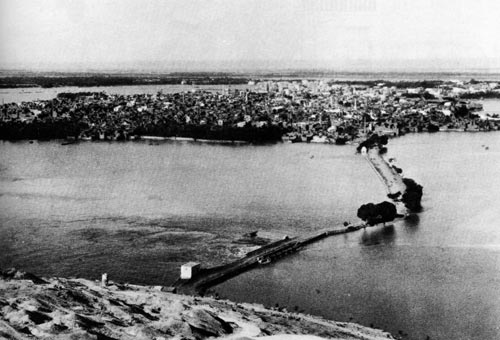
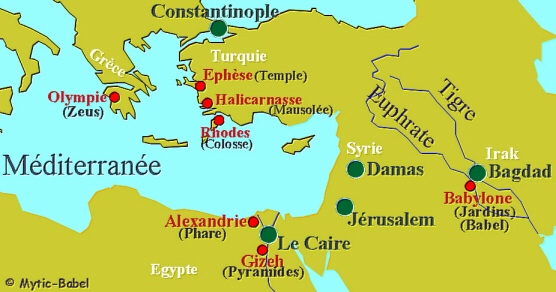
The lighthouse was built on the island of Pharos and soon the building itself acquired the name. The connection of the name with the function became so strong that the word "Pharos" became the root of the word "lighthouse" in the French, Italian, Spanish and Romanian languages.
There are two detailed descriptions made of the lighthouse in the 10th century A.D. by Moorish travelers Idrisi and Yusuf Ibn al-Shaikh. According to their accounts, the building was 300 cubits high. Because the cubit measurement varied from place to place, this could mean that the Pharos stood anywhere from 450 to 600 feet in height, although the lower figure is more likely.
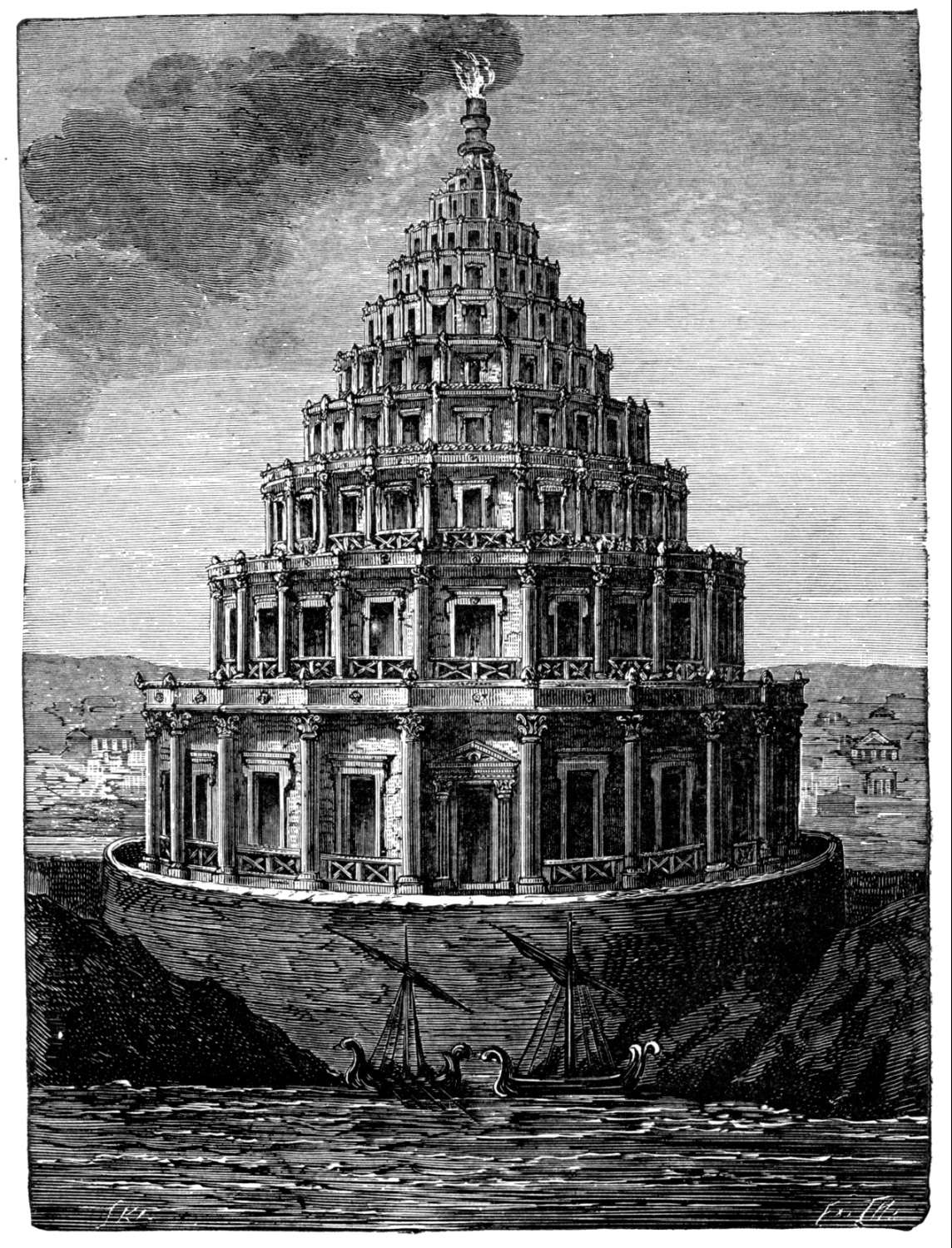
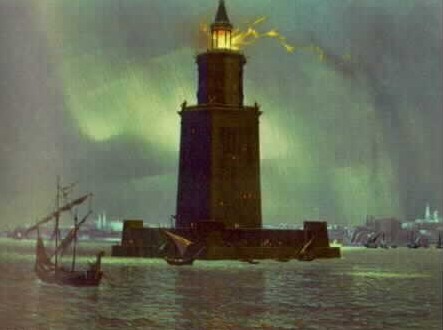
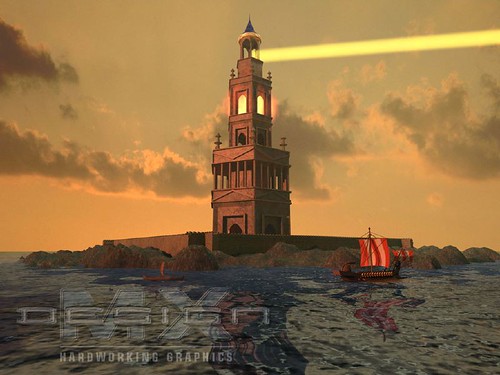
The design was unlike the slim single column of most modern lighthouses (left), but more like the structure of an early twentieth century skyscraper. There were three stages, each built on top of the lower. The building was constructed of marble blocks with lead mortar. The lowest level was probably more that 200 feet in height and 100 feet square, shaped like a massive box. Inside this section was a large spiral ramp that allowed materials to be pulled to the top in horse-drawn carts.
On top of this section was an eight-sided tower. On top of the tower was a cylinder that extended up to an open cupola where the fire that provided the light burned. On the roof of the cupola was a large statue of Poseidon. The lower portion of the building contained hundreds of storage rooms.
The interior of the upper two sections had a shaft with a dumbwaiter that was used to transport fuel up to the fire. Staircases allowed visitors and the keepers to climb to the beacon chamber. There, according to reports, a large curved mirror, perhaps made of polished metal, was used to project the fire's light into a beam. It was said ships could detect the light from the tower at night or the smoke from the fire during the day up to one-hundred miles away.
There are stories that this mirror could be used as a weapon to concentrate the sun and set enemy ships ablaze as they approached. Another tale says that it was possible to use the mirror to magnify the image of the city of Constantinople from far across the sea to observe what was going on there. Both of these stories seem implausible, though.
The lighthouse was apparently a tourist attraction. Food was sold to visitors at the observation platform at the top of the first level. A smaller balcony provided a view from the top of the eight-sided tower for those that wanted to make the additional climb. The view from there must have been impressive as it was probably 300 feet above the sea. There were few places in the ancient world where a person could ascend a man-made tower to get such a perspective.
Destruction
How then did the world's first lighthouse wind up on the floor of the Mediterranean Sea? Most accounts indicate that it, like many other ancient buildings, was the victim of earthquakes. It stood for 1,500 years but was damaged by tremors in 365 and 1303 A.D. Reports indicate the final collapse came in 1326.
There is also an unlikely tale that part of the lighthouse was demolished through trickery. In 850 A.D. the Emperor of Constantinople, a rival port, devised a clever plot to get rid of the Pharos. He spread rumors that buried under the lighthouse was a fabulous treasure. When the Caliph at Cairo who controlled Alexandria heard these rumors, he ordered that the tower be pulled down to get at the treasure. It was only after the great mirror had been destroyed and the top two portions of the tower removed that the Caliph realized he'd been deceived. He tried to rebuild the tower, but couldn't, so he turned it into a mosque instead.
As colorful as this story is there does not seem to be much truth in it. Visitors in 1115 A.D. reported the Pharos intact and still operating as a lighthouse.
Did the divers actually find the remains of Pharos in the bottom of the harbor? Some of the larger blocks of stone found certainly seem to have come from a large building. Statues were located that may have stood at the base of the Pharos. Interestingly enough, much of the material found seems to be from earlier eras than the lighthouse. Scientists speculate that they may have been recycled in the construction of the Pharos from even older buildings.
There are plans to turn this site into an archaeological park with a lighthouse museum. In a few years visitors maybe able to rent snorkle gear and wet suits and dive in the bay among the remains of the great Pharos lighthouse.


 11:05 AM
 crkota