Wednesday, June 3, 2009

Beppu - the “Nine Hells” , Japan


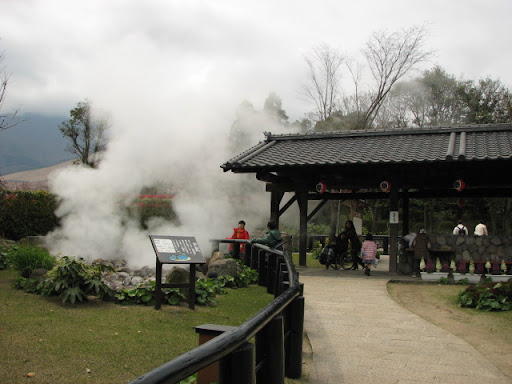
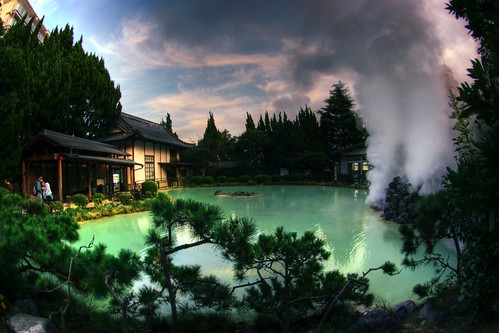
Beppu, located on the Japanese island of KyÅ«shÅ«, is the second largest producer of geothermal water in the world. Located in the same area are the “Nine Hells” or ponds that each has its own remarkable character and colour thanks to the variety of minerals in the outflows. These “Hells” are a popular tourist attraction in Japan but are little known outside of the country. Seven of the strange geothermal springs are located in the Kannawa area and are known as: Sea or Ocean Hell (Umi Jigoku), Shaven Head Hell (Oniishibozu Jigoku), Cooking Pot Hell (Kamado Jigoku), Mountain Hell (Yama Jigoku), Devil or Monster Mountain Hell (Oniyama Jigoku,) Golden Dragon Hell (Kinryu Jigoku) and White Pond Hell (Shiraike Jigoku). Sadly, as with many incredible natural wonders, the area surrounding it has become over commercialised and “tacky”.

Beppu was founded on April 1, 1924. It is famous for its thousands of onsen (hot springs), which are regarded as sacred. Beppu is Japan's onsen capital as it has the largest volume of hot water in the world aside from Yellowstone and the largest number of hot spring sources in Japan.

Kannawa District:


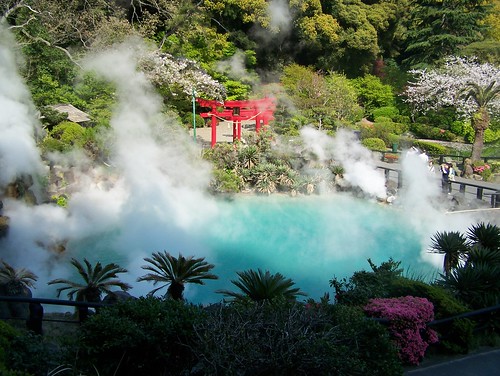
  • Umi Jigoku
The "sea hell" features a pond of hot, blue water. It is one of the more beautiful hells.


  • Oniishibozu Jigoku
This hell is named after the mud bubbles, which emerge from boiling mud pools and look like the shaven heads of monks.


  • Shiraike Jigoku
According to its name, the "white pond hell" features a pond of hot, milky white water.


  • Yama Jigoku
The "mountain hell" features small ponds of steaming hot water and a small zoo with small cages.


  • Kamado Jigoku
The "cooking pot hell" features several boiling ponds and a flashy demon statue as cook.


  • Oniyama Jigoku
Crocodiles are bred and kept on the grounds of the "monster mountain hell".


  • Kinryu Jigoku
The "golden dragon hell" features a dragon statue and a greenhouse, heated by the hot spring.


Shibaseki District:


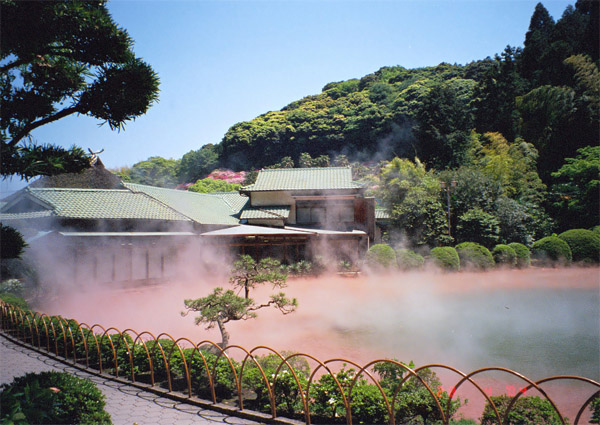
  • Chinoike Jigoku
The "blood pond hell" features a pond of hot, red water. It is the most photogenic of the nine hells.

  • Tatsumaki Jigoku
The "spout hell" features a boiling hot geyser, which erupts every 25-30 minutes for about five minutes.


source 1 2 3

Saturday, May 30, 2009

Pamukkale - Turkey


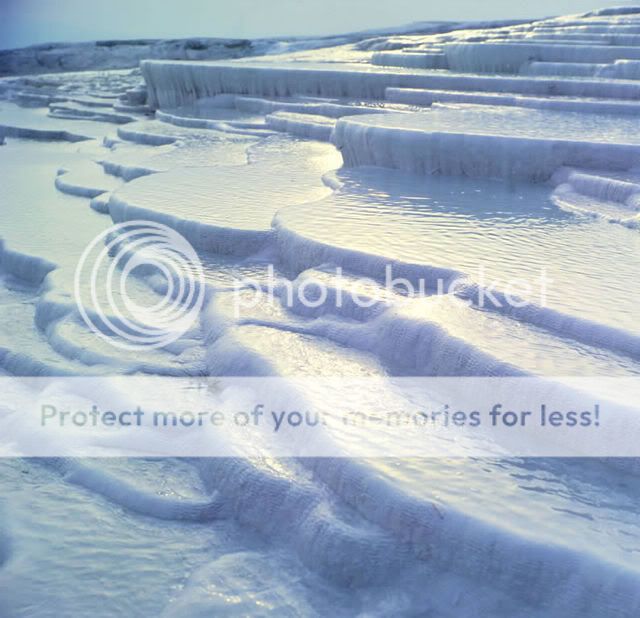
The strange and weirdly beautiful terraced pools of Pamukkale (Pummakale) have been appreciated for over two millennia and yet still remain a little known wonder of the world. Thousands of years ago earthquakes, which are common in Turkey, created fractures that allowed powerful hot springs to bring water rich in calcium carbonate to the surface. As the water evaporated the chalky material condensed and formed layer-upon-layer of Travertine and thus slowly built up the walls over time in the same way that a stalactite forms in a cave. Apparently Pamukkale means Castle of Cotton but the Greco-Romans built a town above it called Heirapolis – meaning “Holy City” or “Sacred City”. They too recognised it as a rare and important place attributing healing powers to the milky-white waters.The travertine features have their origins in the shifting of a fault in the valley of the Menderes river (between here and Denizli). As the fault shifted, very hot springs with a very high mineral content (notably chalk) arose at this location.


source 1 2

Thursday, May 28, 2009

The Colossus of Rhodes


From its building to its destruction lies a time span of merely 56 years. Yet the colossus earned a place in the famous list of Wonders. "But even lying on the ground, it is a marvel", said Pliny the Elder. The Colossus of Rhodes was not only a gigantic statue. It was rather a symbol of unity of the people who inhabited that beautiful Mediterranean island -- Rhodes.
Location
At the entrance of the harbor of the Mediterranean island of Rhodes in Greece.
History
Throughout most of its history, ancient Greece was comprised of city-states which had limited power beyond their boundary. On the small island of Rhodes were three of these: Ialysos, Kamiros, and Lindos. In 408 BC, the cities united to form one territory, with a unified capital, Rhodes. The city thrived commercially and had strong economic ties with their main ally, Ptolemy I Soter of Egypt. In 305 BC, the Antigonids of Macedonia who were also rivals of the Ptolemies, besieged Rhodes in an attempt to break the Rhodo-Egyptian alliance. They could never penetrate the city. When a peace agreement was reached in 304 BC, the Antagonids lifted the siege, leaving a wealth of military equipment behind. To celebrate their unity, the Rhodians sold the equipment and used the money to erect an enormous statue of their sun god, Helios.
The construction of the Colossus took 12 years and was finished in 282 BC. For years, the statue stood at the harbor entrance, until a strong earthquake hit Rhodes about 226 BC. The city was badly damaged, and the Colossus was broken at its weakest point -- the knee. The Rhodians received an immediate offer from Ptolemy III Eurgetes of Egypt to cover all restoration costs for the toppled monument. However, an oracle was consulted and forbade the re-erection. Ptolemy's offer was declined.
For almost a millennium, the statue laid broken in ruins. In AD 654, the Arabs invaded Rhodes. They disassembled the remains of the broken Colossus and sold them to a Jew from Syria. It is said that the fragments had to be transported to Syria on the backs of 900 camels.
Description
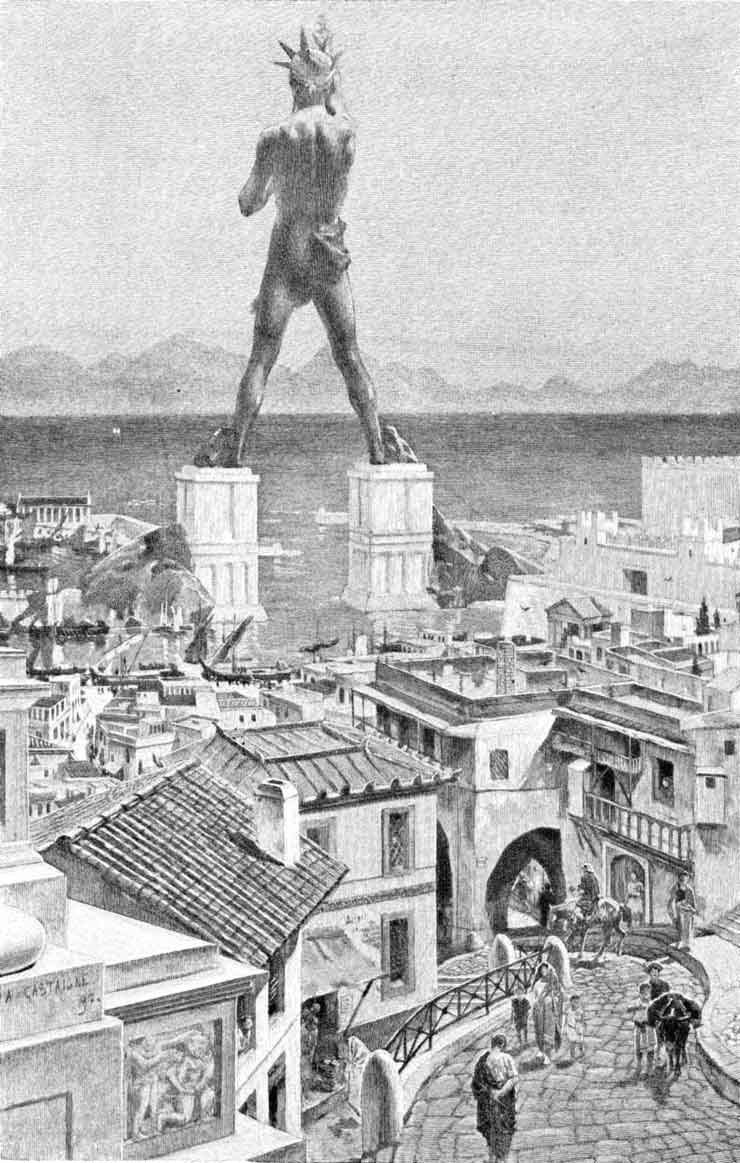
Let us first clear a misconception about the appearance of the Colossus. It has long been believed that the Colossus stood in front of the Mandraki harbor, one of many in the city of Rhodes, straddling its entrance. Given the height of the statue and the width of the harbor mouth, this picture is rather impossible than improbable. Moreover, the fallen Colossus would have blocked the harbor entrance. Recent studies suggest that it was erected either on the eastern promontory of the Mandraki harbor, or even further inland. Anyway, it did never straddle the harbor entrance.
The project was commissioned by the Rhodian sculptor Chares of Lindos. To build the statue, his workers cast the outer bronze skin parts. The base was made of white marble, and the feet and ankle of the statue were first fixed. The structure was gradually erected as the bronze form was fortified with an iron and stone framework. To reach the higher parts, an earth ramp was built around the statue and was later removed. When the colossus was finished, it stood about 33 m (110 ft) high. And when it fell, "few people can make their arms meet round the thumb", wrote Pliny.
Although we do not know the true shape and appearance of the Colossus, modern reconstructions with the statue standing upright are more accurate than older drawings. Although it disappeared from existence, the ancient World Wonder inspired modern artists such as French sculptor Auguste Bartholdi best known by his famous work: The Statue of Liberty.

Wednesday, May 27, 2009

The Mausoleum at Halicarnassus


Similar to the Great Pyramid, we are now visiting the burial place of an ancient king. Yet the Mausoleum is different - so different from the Pyramid that it earned its reputation - and a spot within the list - for other reasons. Geographically, it is closer to the Temple of Artemis... And it was the beauty of the tomb rather than its size that fascinated its visitors for years.
  • Location
In the city of Bodrum (f.k.a. Halicarnassus) on the Aegean Sea, in south-west Turkey.
  • History
When the Persians expanded their ancient kingdom to include Mesopotamia, Northern India, Syria, Egypt, and Asia Minor, the king could not control his vast empire without the help of local governors or rulers -- the Satraps. Like many other provinces, the kingdom of Caria in the western part of Asia Minor (Turkey) was so far from the Persian capital that it was practically autonomous. From 377 to 353 BC, king Mausollos of Caria reigned and moved his capital to Halicarnassus. Nothing is exciting about Maussollos life except the construction of his tomb. The project was conceived by his wife and sister Artemisia, and the construction might have started during the king's lifetime. The Mausoleum was completed around 350 BC, three years after Maussollos death, and one year after Artemisia's.
For 16 centuries, the Mausoleum remained in good condition until an earthquake caused some damage to the roof and colonnade. In the early fifteenth century, the Knights of St John of Malta invaded the region and built a massive crusader castle. When they decided to fortify it in 1494, they used the stones of the Mausoleum. By 1522, almost every block of the Mausoleum had been disassembled and used for construction.
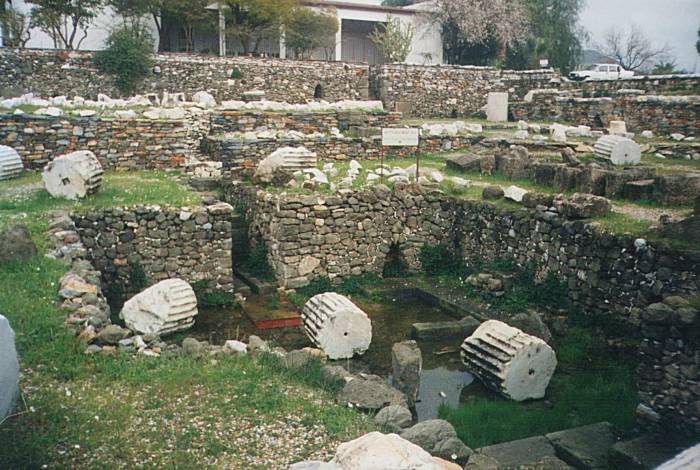
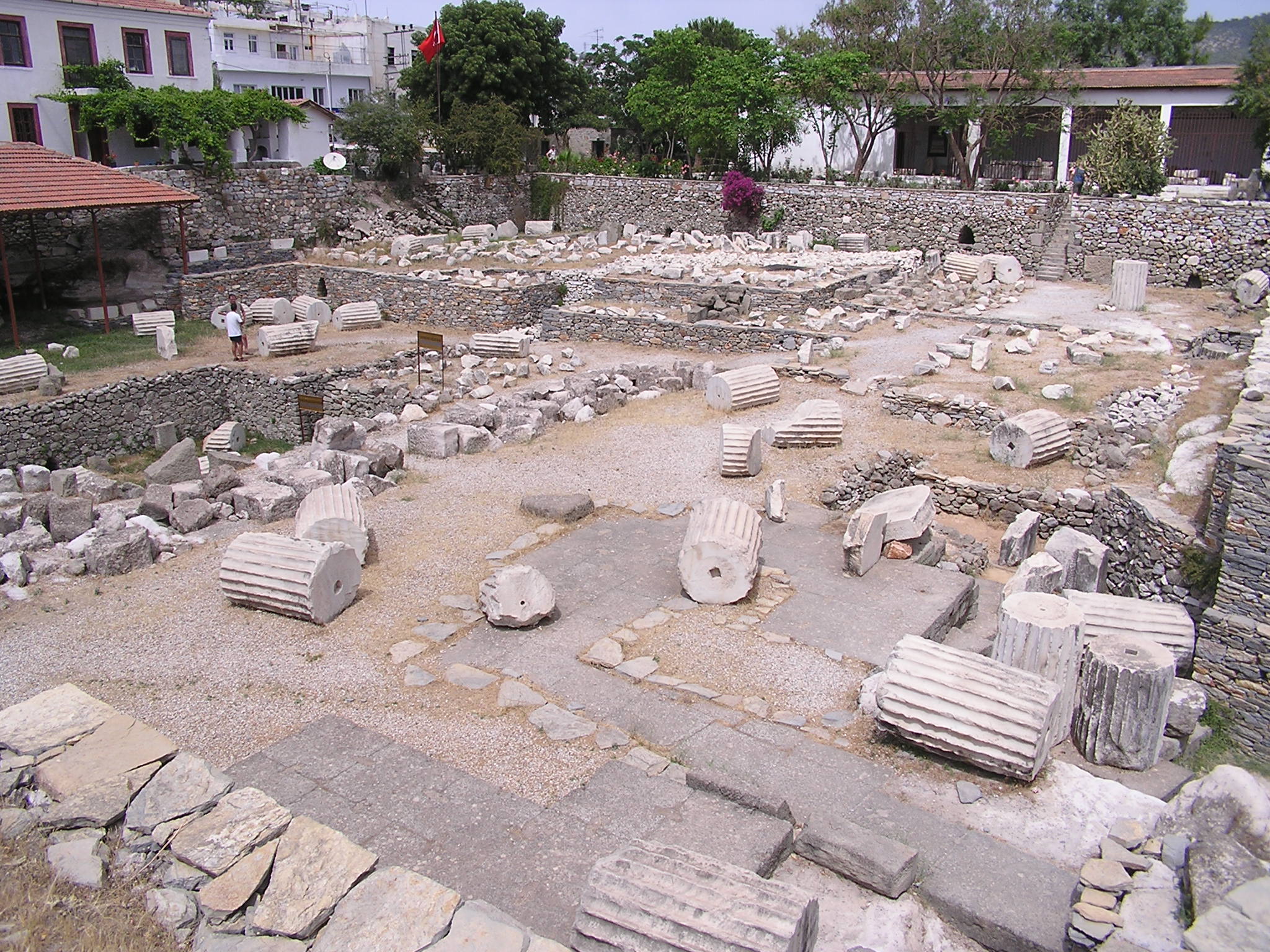
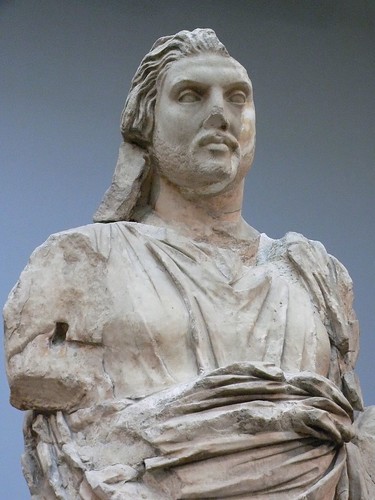
Today, the massive castle still stands in Bodrum, and the polished stone and marble blocks of the Mausoleum can be spotted within the walls of the structure. Some of the sculptures survived and are today on display at the British Museum in London. These include fragment of statues and many slabs of the frieze showing the battle between the Greeks and the Amazons. At the site of the Mausoleum itself, only the foundation remains of the once magnificent Wonder.
  • Description
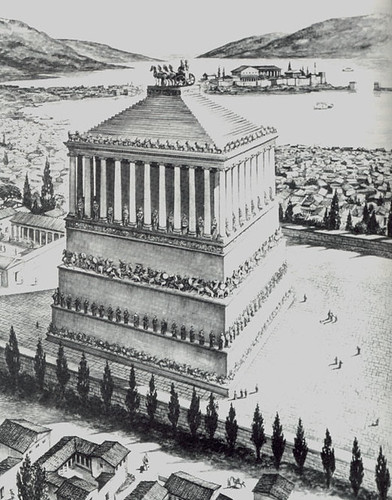
The structure was rectangular in plan, with base dimensions of about 40 m (120 ft) by 30 m (100 ft). Overlying the foundation was a stepped podium which sides were decorated with statues. The burial chamber and the sarcophagus of white alabaster decorated with gold were located on the podium and surrounded by Ionic columns. The colonnade supported a pyramid roof which was in turn decorated with statues. A statue of a chariot pulled by four horses adorned the top of the tomb.
The total height of the Mausoleum was 45 m (140 ft). This is broken down into 20 m (60 ft) for the stepped podium, 12 m (38 ft) for the colonnade, 7 m (22 ft) for the pyramid, and 6 m (20 ft) for the chariot statue at the top.
The beauty of the Mausoleum is not only in the structure itself, but in the decorations and statues that adorned the outside at different levels on the podium and the roof. These were tens of life-size as well as under and over life-size free-standing statues of people, lions, horses, and other animals. The statues were carved by four Greek sculptors: Bryaxis, Leochares, Scopas, and Timotheus, each responsible for one side. Because the statues were of people and animals, the Mausoleum holds a special place in histroy as it was not dedicated to the gods of Ancient Greece.
Since the nineteenth century, archeological excavations have been undertaken at the Mausoleum site. These excavations together with detailed descriptions by ancient historians give us a fairly good idea about the shape and appearance of the Mausoleum. A modern reconstruction of the shorter side of the Mausoleum illustrates the lavish nature of the art and architecture of the building... a building for a King whose name is celebrated in all large tombs today -- mausoleums.


Twitter Delicious Facebook Digg Stumbleupon Favorites More

 
Design by Free WordPress Themes | Bloggerized by Lasantha - Premium Blogger Themes | GreenGeeks Review